Can You Cut COB LED Strip Lights? A Quick Explainer
COB LED strip lights have become one of the most popular lighting solutions for modern homes, commercial spaces, and creative interior projects. Their smooth, dot-free illumination and flexible installation options make them ideal for applications such as cabinet lighting, ceiling accents, display shelves, and architectural decoration.
However, one common question many people ask before installation is: Can you cut COB LED strip lights?
The answer is yes, most COB LED strip lights can be cut, but they must be cut at the correct locations and installed properly to maintain performance and safety.
Understanding where to cut, how to reconnect the strips, and what mistakes to avoid will help you get the best results from your COB LED lighting project.
Can COB LED Strip Lights Be Cut?
Yes, COB LED strip lights are designed with specific cutting points that allow users to adjust the length according to their installation needs.
Unlike traditional lighting fixtures that come in fixed sizes, LED strips are flexible and can be customized for different spaces. Whether you need a short section for a bookshelf or a longer run for ceiling lighting, cutting allows the strip to fit your exact design requirements.
However, you should never cut a COB LED strip randomly. Cutting between the wrong sections may damage the circuit and cause part of the strip to stop working.
Where Should You Cut a COB LED Strip?
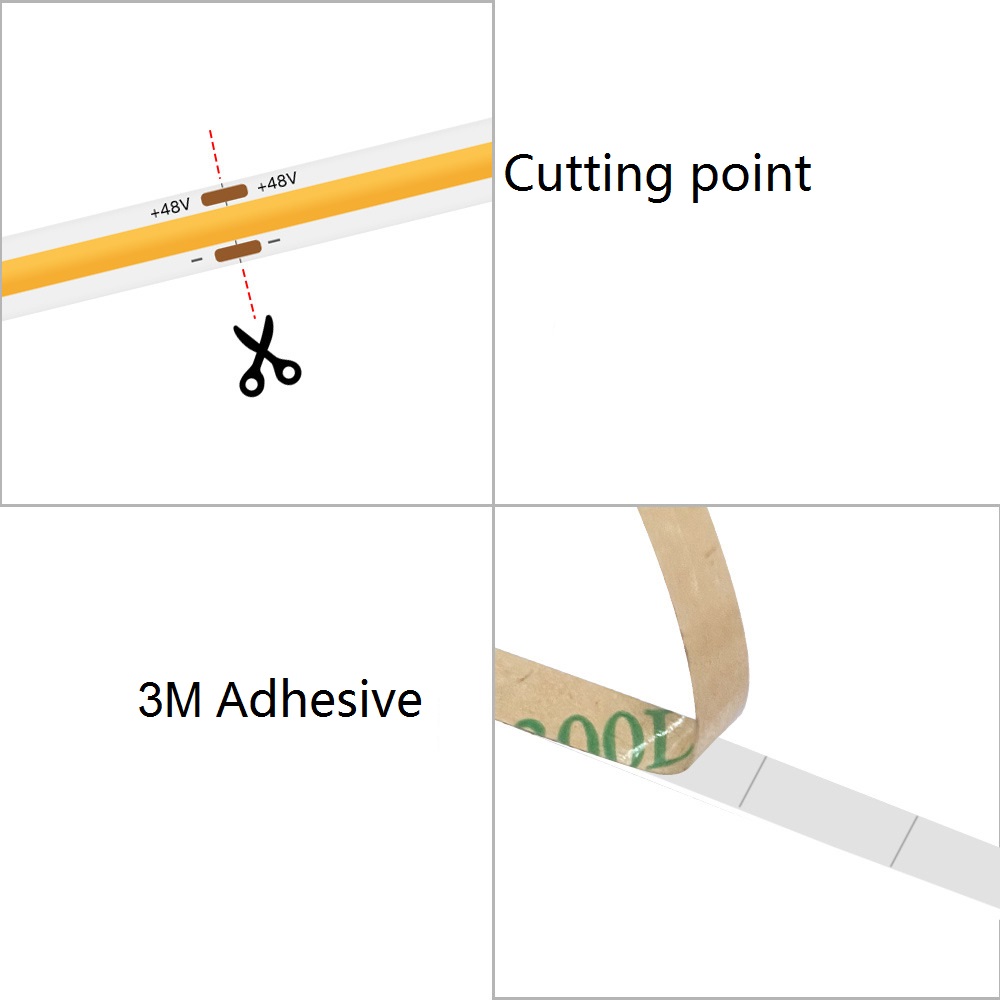
Every COB LED strip has marked cutting points, usually shown by a small line, scissors symbol, or copper contact area on the PCB.
These marks indicate safe cutting locations where the electrical circuit is designed to be separated.
Common cutting intervals include:
· Every 25mm
· Every 50mm
· Every 100mm
The exact cutting distance depends on the LED strip design, voltage, and circuit structure.
Before cutting, always check:
· The printed cutting marks
· The strip voltage
· The manufacturer's specifications
Professional COB LED strip manufacturers usually design cutting points carefully to make installation easier while maintaining stable electrical performance.
What Happens If You Cut a COB LED Strip Incorrectly?
Cutting outside the marked areas can create several problems.
Possible issues include:
· A section of LEDs not lighting up
· Uneven brightness
· Circuit damage
· Short circuits
· Reduced product lifespan
Because COB LED strips contain multiple LED chips connected through a designed circuit pattern, cutting in the wrong place may interrupt the electrical connection.
Taking a few seconds to identify the correct cutting point can prevent unnecessary damage.
How to Cut COB LED Strip Lights Correctly
Cutting a COB LED strip is relatively simple when done properly.
Follow these steps:
1. Measure the Installation Area
Before cutting, measure the exact length required. It is better to leave a small extra margin rather than cutting too short.
Consider corners, connectors, and installation space when measuring.
2. Disconnect the Power
Always turn off and disconnect the power supply before cutting the LED strip.
Never cut or modify an LED strip while it is connected to electricity.
3. Find the Cutting Mark
Locate the copper cutting line or scissors symbol on the COB LED strip.
Only cut directly along this marked position.
4. Use Proper Cutting Tools
Use sharp scissors or a precision cutting tool to make a clean cut.
A rough or uneven cut can make it harder to connect the strip properly later.
5. Protect the Cut End
After cutting, the exposed circuit area may need protection depending on the installation environment.
For indoor applications, connectors may be sufficient. For humid locations, additional waterproof protection may be required.
How to Connect Cut COB LED Strip Sections
After cutting a COB LED strip, there are several ways to reconnect it.
Using LED Strip Connectors
Clip-on connectors are the easiest option for DIY installations.
Advantages:
· Quick installation
· No soldering required
· Easy adjustment
However, connector quality matters. Poor connectors may create loose connections or unstable lighting.
Using Soldering
For professional installations, soldering is often preferred.
Benefits include:
· Stronger electrical connection
· Better reliability
· More compact appearance
· Suitable for custom designs
Many commercial lighting projects use soldered connections because they provide better long-term stability.
Can You Cut Waterproof COB LED Strips?
Yes, but extra care is required.
Waterproof COB LED strips often have silicone coatings or protective layers. When cut, the waterproof seal is broken at the cutting point.
After cutting, you may need to:
· Reapply silicone protection
· Use waterproof connectors
· Seal the connection point properly
For indoor areas such as bedrooms or living rooms, this is usually less of a concern. For kitchens, bathrooms, outdoor areas, or commercial environments, proper waterproof treatment is important.
Does Cutting Affect COB LED Strip Brightness?
If cut correctly, the brightness of the remaining strip should not be affected.
Each section of the COB LED strip is designed to operate independently according to its circuit structure.
However, brightness problems may occur if:
· The wrong power supply is used
· The strip is too long for the voltage system
· Poor-quality connectors are installed
· The cut connection is unstable
Choosing a reliable COB LED strip with proper circuit design helps maintain consistent lighting performance after customization.
How Many Times Can You Cut a COB LED Strip?
There is no fixed limit to how many times a COB LED strip can be cut.
The limitation depends on:
· The cutting interval
· The total installation design
· Connection methods
· Power supply arrangement
For example, a strip with shorter cutting intervals provides more flexibility for detailed projects, while strips with longer intervals may be better suited for simple straight installations.
Common Mistakes When Cutting COB LED Strips
Many installation problems come from avoidable mistakes.
Cutting Without Checking Markings
Never assume where to cut. Always follow the manufacturer's cutting points.
Using the Wrong Voltage After Cutting
A 24V COB LED strip requires a compatible 24V power supply even after being shortened.
Overloading Long Strip Runs
If multiple sections are connected together, make sure the power supply can handle the total wattage.
Ignoring Heat Management
Even after cutting, proper installation and heat dissipation remain important, especially for high-power COB LED strips.
Choosing a COB LED Strip Designed for Easy Installation
A well-designed COB LED strip should not only provide excellent lighting quality but also make installation simple.
Important features to consider include:
· Clearly marked cutting points
· Stable PCB design
· Reliable LED chips
· Consistent brightness
· Suitable voltage options
· Good heat management
Professional LED suppliers focus on these details to ensure that installers and end users can customize products easily without sacrificing reliability. Brands such as LEDWAY provide COB LED strip solutions designed for various residential and commercial applications, offering flexibility for different lighting projects.
So, can you cut COB LED strip lights? Yes, absolutely. Cutting is one of the biggest advantages of LED strip lighting, allowing users to create customized lighting designs for almost any space.
The key is to cut only at the marked points, use proper connectors or soldering methods, and choose a quality product designed for reliable performance.
With the right installation approach, COB LED strip lights can be easily customized to create clean, modern, and professional-looking lighting effects.
For professional COB LED strip solutions, customized lighting projects, or product inquiries, contact LEDWAY:
Email: sales2@ledwaylighting.com

High Quality Assurance Professional choice factory supply.

Excellent public repution reassured purchasing

Professional design Personalized lighting product idea design

Fast sample making | fast proofingSamples can be made within 48 hours
About
SHENZHEN LEDWAY LIGHTING CO.,Ltd is a manufacturer which integrating R&D, manufacture and sales. Current factory area is 1800 ㎡, 5 high spend SMT machines, 2 reflow soldering machines, 5 production lines, 80 skilled workers as well as the professional R&D team, sales and service team...
In the past 10 years, LEDway focuses on led strip, such as DC&HV strip, COB&SMD strip, neon led strip, have rich-experience in led strip area. In recent year, with strong R&D ability, we also have developed led cabinet light, sensor night light, atmosphere light. Hot selling in Americas and European market. Most of our products have passed CE ROHS, ETL, GS, KC..
Contacts
-
- Address
- The 5rd floor, factory building, Jianghai industrial Park, Yonghe road No. 7, Shiyan street, Baoan district, Shenzhen, China.
-
- jelly@ledwaylighting.com
-
- We are open
- Mon-Fri: 08:00 - 18:00