What Power Supply Do You Need for a COB LED Strip?
COB LED strip lights are widely used in modern lighting projects because they provide smooth illumination, flexible installation, and excellent energy efficiency. Whether you are installing LED strips under kitchen cabinets, inside wardrobes, along ceilings, or in commercial spaces, choosing the right power supply is one of the most important steps.
A high-quality COB LED strip can only perform well when paired with a suitable power supply. Using the wrong power supply may lead to problems such as flickering, reduced brightness, overheating, or even damage to the LED strip.
So, what power supply do you need for a COB LED strip?
The answer depends on several factors, including voltage, wattage, strip length, and installation environment.
This guide explains how to choose the correct power supply for COB LED strip lights.
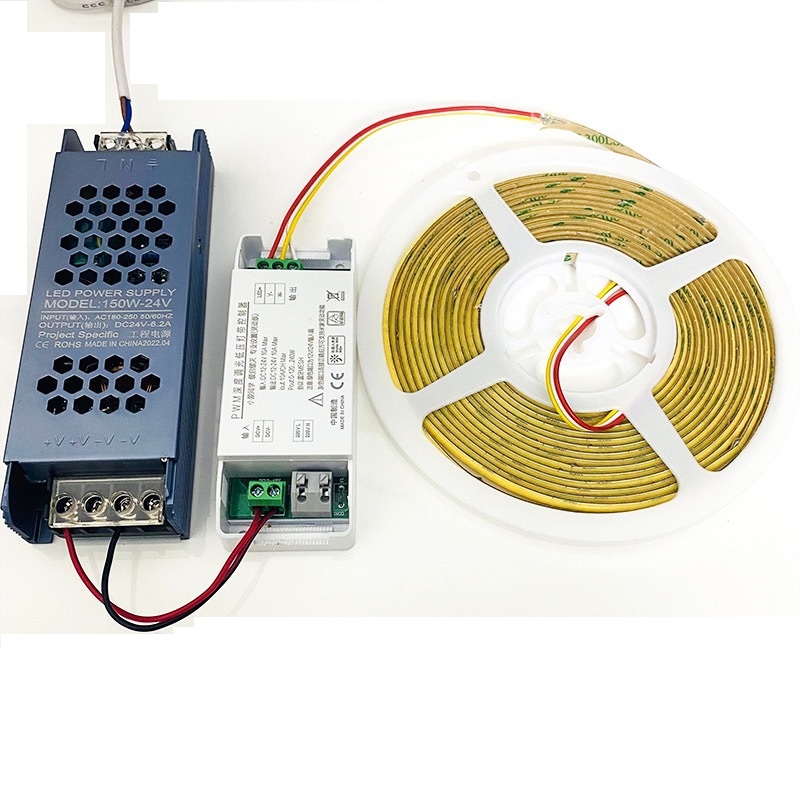
Why Does a COB LED Strip Need a Power Supply?
Most COB LED strips operate on low-voltage DC power, commonly 12V or 24V, while household electricity is usually much higher voltage.
A power supply, also known as an LED driver or transformer, converts standard AC power into the low-voltage DC power required by the LED strip.
The power supply provides:
· Stable voltage output
· Safe operation
· Consistent brightness
· Protection against electrical issues
Without a properly matched power supply, the LED strip may not operate correctly or may experience performance problems over time.
Step 1: Check the Voltage of Your COB LED Strip
The first step when choosing a power supply is matching the voltage.
Common COB LED strip voltages include:
12V COB LED Strips
12V LED strips are often used for:
· Small decorative projects
· Short cabinet lighting
· DIY installations
· Furniture lighting
Advantages:
· Easy to install
· More flexible for small projects
· Widely available
However, 12V strips usually experience more voltage drop over long distances.
24V COB LED Strips
24V LED strips are increasingly popular for professional lighting applications.
They are suitable for:
· Longer installations
· Ceiling lighting
· Commercial projects
· Large decorative areas
Advantages:
· Lower voltage drop
· Better brightness consistency
· More efficient for longer runs
For many modern lighting projects, 24V COB LED strips provide a better balance between performance and reliability.
Step 2: Calculate the Required Power Supply Wattage
After confirming the voltage, the next step is calculating the required wattage.
The basic formula is:
Total Power = LED Strip Length × Power Consumption per Meter
For example:
A COB LED strip uses:
· 10W per meter
· 5 meters installation length
Calculation:
10W × 5m = 50W
The LED strip requires approximately 50W of power.
However, it is recommended not to run a power supply at 100% capacity.
A safety margin of around 20%–30% extra power is commonly recommended.
In this example:
50W × 1.2 = 60W
A 60W or higher power supply would be a better choice.
Why You Should Not Use an Undersized Power Supply
Some users choose a smaller power supply to reduce cost, but this can create problems.
An overloaded power supply may cause:
· Flickering lights
· Reduced brightness
· Excessive heat
· Shorter lifespan
· Unexpected shutdowns
For reliable operation, the power supply should have enough capacity to handle the LED strip load comfortably.
Step 3: Consider the Length of the COB LED Strip
The length of the LED strip directly affects power requirements.
For example:
A 10-meter COB LED strip will require much more power than a 2-meter strip.
Long installations also introduce another issue: voltage drop.
Voltage drop can cause:
· The beginning of the strip being brighter than the end
· Uneven lighting
· Lower brightness in longer sections
To reduce voltage drop:
· Choose 24V COB LED strips for longer runs
· Use power injection when necessary
· Avoid connecting excessive lengths in one continuous line
Professional LED installations often consider power distribution during the design stage to maintain consistent lighting performance.
Step 4: Choose the Right Type of Power Supply
Different applications require different power supply designs.
Standard Indoor LED Power Supply
For indoor applications such as bedrooms, living rooms, and cabinets, a standard enclosed LED power supply is usually sufficient.
Suitable for:
· Home decoration
· Furniture lighting
· Ceiling accents
· Display shelves
These power supplies are compact and cost-effective.
Dimmable LED Power Supply
If you want brightness control, you need a compatible dimming system.
Dimmable power supplies work with:
· LED dimmers
· Smart controllers
· Wall panels
· Home automation systems
They are ideal for projects where lighting atmosphere needs to change throughout the day.
Waterproof LED Power Supply
For outdoor or humid environments, the power supply should also have appropriate protection.
Applications include:
· Outdoor decoration
· Garden lighting
· Covered patios
· Commercial outdoor displays
Remember that even if your COB LED strip is waterproof, the power supply must also be protected from moisture.
Step 5: Choose a Reliable Power Supply Quality Level
The quality of the power supply directly affects LED strip performance.
A low-quality power supply may cause:
· Flickering
· Electrical noise
· Unstable brightness
· Shorter LED lifespan
A reliable power supply should provide:
· Stable voltage output
· Overload protection
· Short-circuit protection
· Good heat management
Professional LED manufacturers usually test LED strips together with suitable power solutions to ensure stable operation.
Brands such as LEDWAY focus on complete LED lighting solutions, helping customers select COB LED strips and compatible power systems for residential and commercial applications.
Can One Power Supply Run Multiple COB LED Strips?
Yes, one power supply can run multiple COB LED strips as long as the total wattage does not exceed the power supply capacity.
For example:
Two LED strips:
· Strip A: 30W
· Strip B: 40W
Total:
30W + 40W = 70W
A power supply rated above 70W with proper safety margin would be required.
However, for large installations, separating power zones may provide better performance and easier maintenance.
Common Power Supply Mistakes to Avoid
Using the Wrong Voltage
A 12V power supply cannot properly power a 24V LED strip, and vice versa.
Always match the voltage exactly.
Choosing the Same Wattage Without Extra Capacity
A 100W LED strip should not run on a 100W power supply continuously.
Allow additional capacity for safer operation.
Ignoring Heat Dissipation
Power supplies generate heat during operation.
Avoid installing them in completely enclosed spaces without ventilation.
Using Long LED Runs Without Planning Power Injection
Long strips may suffer from brightness differences if power distribution is not designed correctly.
Recommended Power Supply Examples
Here are some general examples:
Small Home Project
COB LED strip:
· 3 meters
· 8W/m
Calculation:
3 × 8W = 24W
Recommended power supply:
12V/24V, around 30W–40W
Medium Installation
COB LED strip:
· 8 meters
· 10W/m
Calculation:
8 × 10W = 80W
Recommended power supply:
Around 100W capacity
Large Lighting Project
COB LED strip:
· 15 meters
· 15W/m
Calculation:
15 × 15W = 225W
Recommended solution:
Use a higher-power supply or divide the installation into multiple circuits.
Final Thoughts
Choosing the right power supply is essential for getting the best performance from COB LED strip lights.
The key factors to remember are:
· Match the voltage (12V or 24V)
· Calculate total wattage
· Add a safety margin
· Consider strip length and voltage drop
· Choose a reliable power supply
A properly matched power supply helps COB LED strips deliver stable brightness, better efficiency, and longer service life.
Whether you are creating home lighting, commercial displays, or custom architectural projects, selecting the right LED strip and power solution will make a significant difference.
For professional COB LED strip solutions, customized lighting projects, or power supply recommendations, contact LEDWAY:
Email: sales2@ledwaylighting.com

High Quality Assurance Professional choice factory supply.

Excellent public repution reassured purchasing

Professional design Personalized lighting product idea design

Fast sample making | fast proofingSamples can be made within 48 hours
About
SHENZHEN LEDWAY LIGHTING CO.,Ltd is a manufacturer which integrating R&D, manufacture and sales. Current factory area is 1800 ㎡, 5 high spend SMT machines, 2 reflow soldering machines, 5 production lines, 80 skilled workers as well as the professional R&D team, sales and service team...
In the past 10 years, LEDway focuses on led strip, such as DC&HV strip, COB&SMD strip, neon led strip, have rich-experience in led strip area. In recent year, with strong R&D ability, we also have developed led cabinet light, sensor night light, atmosphere light. Hot selling in Americas and European market. Most of our products have passed CE ROHS, ETL, GS, KC..
Contacts
-
- Address
- The 5rd floor, factory building, Jianghai industrial Park, Yonghe road No. 7, Shiyan street, Baoan district, Shenzhen, China.
-
- jelly@ledwaylighting.com
-
- We are open
- Mon-Fri: 08:00 - 18:00