Are COB LED Strips Worth the Extra Cost? A Detailed Breakdown
When planning an architectural or high-end residential lighting scheme, one material choice comes up repeatedly during specification: Should you stick with traditional SMD (Surface-Mounted Device) LED strips, or upgrade to COB (Chip-on-Board) tape?
On average, COB LED strips carry a 20% to 40% price premium over standard SMD options.
Does the performance of COB justify the higher upfront spend, or are you paying for a trend? Below is an engineering and economic breakdown of where COB delivers a clear return on investment—and where traditional SMD strips still make sense.
The Upfront Cost Difference: What Are You Paying For?
The cost difference between SMD and COB is rooted in packaging and material density:
SMD Strips:
Use individually packaged LED diodes (such as SMD 2835 or 5050) spaced at regular intervals along a flexible circuit board. A typical high-density SMD strip contains 120 to 240 chips per meter. COB Strips:
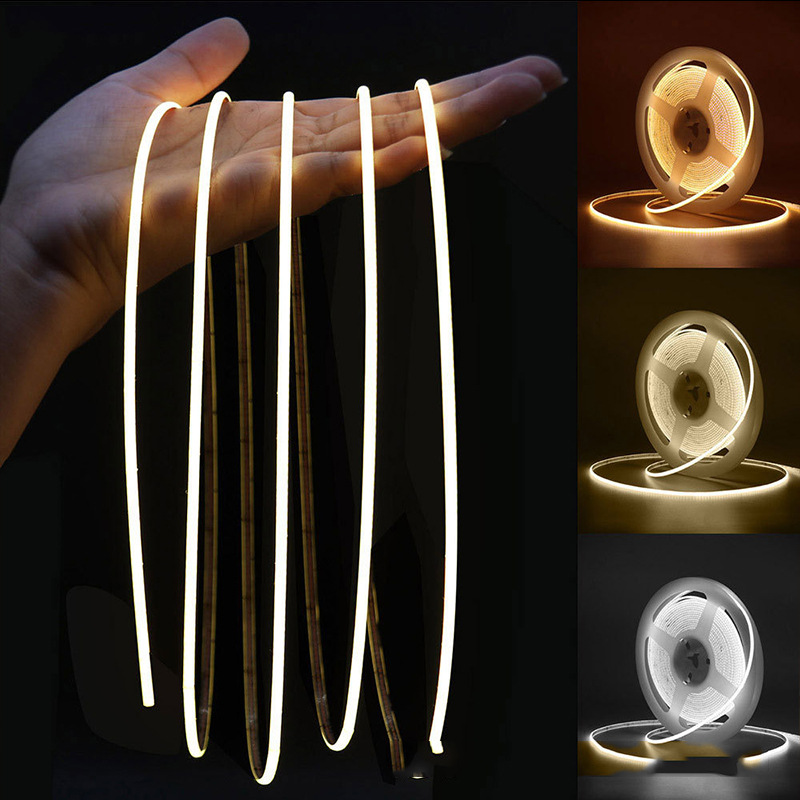
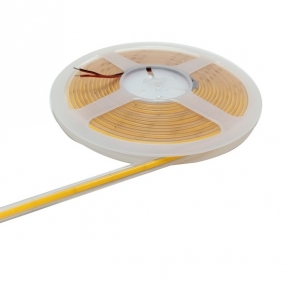
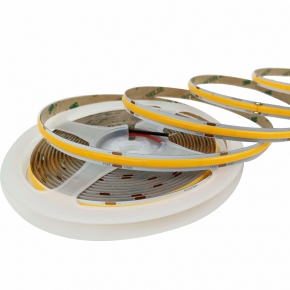
Mount bare semiconductor dies directly onto the flexible PCB via flip-chip technology, covered by a continuous layer of silicone phosphor. COB strips house 480 to 840 micro-chips per meter.
[SMD Packaging Costs]
Solder 240 Individual Diode Packages → Standard PCB → Moderate Material Density

[COB Packaging Costs]
Mount 512+ Bare Chips Directly → Continuous Phosphor Pour → High Copper Substrate Density
You are primarily paying for higher chip density, advanced flip-chip assembly, and specialized phosphor coating processes.
4 Areas Where COB Delivers Real ROI
1. Eliminating the Profile & Diffuser Bottleneck
With standard SMD strips, achieving a smooth, dotless beam requires pairing the tape with a deep aluminum channel and a heavily frosted plastic diffuser.
Frosted diffusers act like dark sunglasses: they block hotspots, but they also absorb 20% to 35% of the total light output.
Because COB strips are naturally dotless straight out of the package, you can run them inside ultra-shallow channels or use clear covers with minimal light attenuation.
The Cost Offset: You save money on aluminum profile depth, hardware footprint, and wasted power from over-driven LEDs fighting dense diffusers.
[Installed System Efficiency Comparison]

SMD + Heavy Frosted Diffuser:
1,500 lumens generated → 30% lost to diffusion → 1,050 delivered lumens

COB + Clear/Light Diffuser:
1,300 lumens generated → 5% lost to diffusion → 1,235 delivered lumens
2. Labor and Call-Back Reductions
In commercial builds, call-backs kill profit margins. Traditional SMD strips rely on wire-bonded package connections soldered at hundreds of individual points. Frequent bending during installation can cause micro-cracks in solder joints, leading to dead sections over time.
COB's flip-chip architecture distributes thermal and mechanical stress evenly across the substrate. Fewer solder joint vulnerabilities translate to lower failure rates on site, reducing warranty service visits.
3. Aesthetics on Reflective Surfaces
If light hits polished quartz, marble, high-gloss lacquer, or glass, standard SMD strips mirror as harsh, distracting point sources. Fixing this post-installation often requires tearing out millwork to insert deeper channels.
Specifying COB upfront guarantees a seamless reflection, preventing costly retrofits or client rejections during final punch-list sign-offs.
4. Wider, Softer Beam Spread
Standard SMD diodes cast light at roughly a 120 angle. COB's continuous gel layer broadens the beam angle to nearly 180. This wide wash provides better fill light in shallow coves and cabinet kick-spaces, allowing you to achieve rich ambient lighting with fewer fixtures.
Cost vs.
| Metric / Scenario | Standard SMD LED Strip | Advanced COB LED Strip | Financial Winner |
| Raw Material Cost | Baseline ($) | +20% to +40% ($$) | SMD |
| Shallow Channel Integration | Poor (Requires deep extrusions) | Excellent (Works in $le 5text{ mm}$ profiles) | COB |
| Reflective Surface Performance | Shows harsh mirror dots | Completely seamless optical line | COB |
| Hidden Cove / Indirect Light | Smooth wash when hidden | Identical result when hidden | SMD |
| High Output / Peak Lumens | High raw lumen potential | Slightly lower raw efficacy per watt | SMD |
When Is SMD Still the Smarter Choice?
COB isn't necessary for every meter of tape in a building. SMD strips remain the most cost-effective solution when:
The light source is indirect and deep: High-ceiling coves, curtain drops, or deep soffits where the strip is completely hidden from view and bounces off a matte surface.
Maximum gross lumen output is needed: Industrial or direct task lighting where sheer lumen output per dollar trumps optical smoothness.
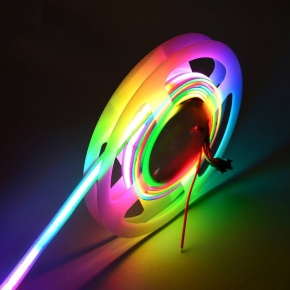
Complex dynamic RGB/Pixel chasing: While addressable COB exists, complex pixel-controlled dynamic effects are more mature and economical in SMD formats.
The Verdict: Are COB Strips Worth It?
For direct-view installations, shallow aluminum profiles, and reflective surfaces, COB LED strips are easily worth the extra cost.
For hidden architectural coves and high-bay indirect washes, stick with high-efficacy SMD tape and put the saved budget toward controls or drivers.
To maximize value on commercial projects, work with engineering-driven linear suppliers like LEDWAY that specialize in both high-binning COB arrays and efficient SMD solutions. Selecting a vendor with strict thermal and CCT tolerances ensures your COB installations perform reliably over their full service life.
Project Inquiries & Technical Support
Need photometric data, sample kits, or custom aluminum profile pairings for your upcoming lighting project? Reach out to our technical sales team at sales2@ledwaylighting.com.

High Quality Assurance Professional choice factory supply.

Excellent public repution reassured purchasing

Professional design Personalized lighting product idea design

Fast sample making | fast proofingSamples can be made within 48 hours
About
SHENZHEN LEDWAY LIGHTING CO.,Ltd is a manufacturer which integrating R&D, manufacture and sales. Current factory area is 1800 ㎡, 5 high spend SMT machines, 2 reflow soldering machines, 5 production lines, 80 skilled workers as well as the professional R&D team, sales and service team...
In the past 10 years, LEDway focuses on led strip, such as DC&HV strip, COB&SMD strip, neon led strip, have rich-experience in led strip area. In recent year, with strong R&D ability, we also have developed led cabinet light, sensor night light, atmosphere light. Hot selling in Americas and European market. Most of our products have passed CE ROHS, ETL, GS, KC..
Contacts
-
- Address
- The 5rd floor, factory building, Jianghai industrial Park, Yonghe road No. 7, Shiyan street, Baoan district, Shenzhen, China.
-
- jelly@ledwaylighting.com
-
- We are open
- Mon-Fri: 08:00 - 18:00