The Science Behind Dotless Lighting: How COB LED Strips Eliminate Hotspots
If you’ve ever installed a traditional flexible LED strip beneath an upper cabinet or inside a sleek aluminum channel, you know the frustration: instead of a clean, continuous wash of illumination, you’re left with a harsh series of visible bright spots—commonly known in the industry as the "dot effect" or hotspots.
For years, lighting designers and contractors relied on deep extrusions and frosted plastic diffusers to soften these glaring gaps. But as architectural trends lean heavier into ultra-slim profiles and direct-view accent lighting, optical diffusion alone isn't enough.
Enter COB (Chip-on-Board) LED technology. By fundamentally altering how diodes are packaged and powered, COB strips deliver continuous, dotless linear light straight from the tape.
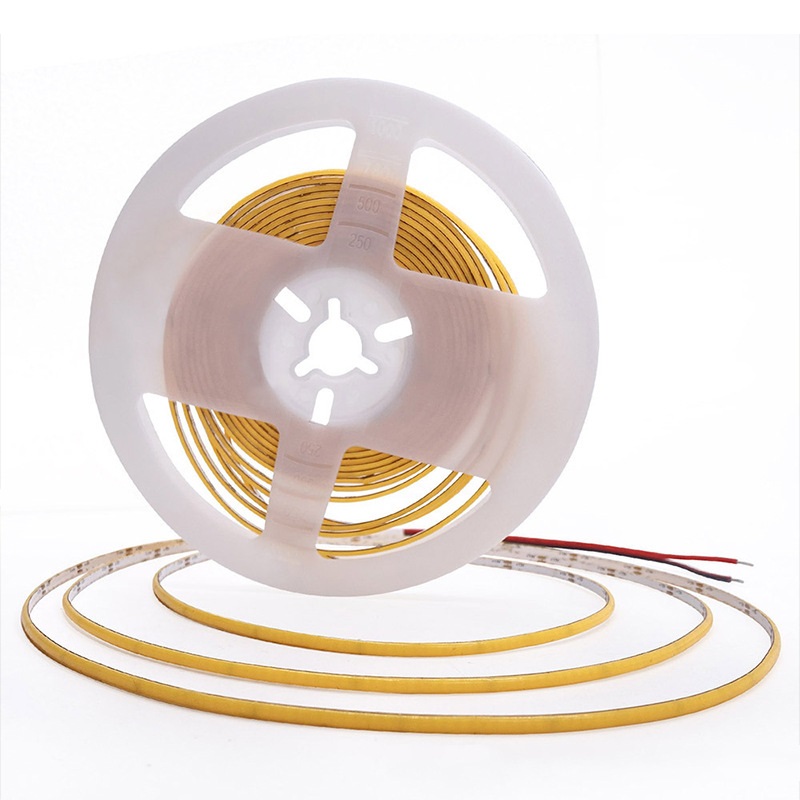
Here is a breakdown of the physics and engineering behind COB LED strips, why they eliminate hotspots, and what to consider when specifying them for your next project.
Why Traditional Surface-Mount LEDs Spot
To understand why COB works, it helps to look at why classic SMD (Surface-Mount Device) LEDs create hotspots.
Traditional LED strips use discrete packages—like SMD 2835 or 5050—soldered at spaced intervals along a flexible printed circuit board (FPCB). Each package contains a synthetic substrate, an LED die, wire bonds, and a drop of phosphor resin.
[SMD Strip Visual]
[Die] ... Gap ... [Die] ... Gap ... [Die]
  ↓                 ↓                 ↓
Hotspot          Dark Space        Hotspot
Because these diodes are spaced anywhere from 10 mm to 30 mm apart, light leaves each package as a conical beam (typically at a $120^circ$ beam angle). Where these beams overlap, illumination is strong; in the physical gaps between them, lumen output dips. When placed near a reflective surface—like polished marble, glass, or quartz countertops—those bright peaks reflect as distinct, distracting dots.
The Engineering Behind COB: Eliminating the Gaps
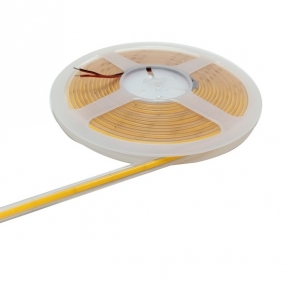
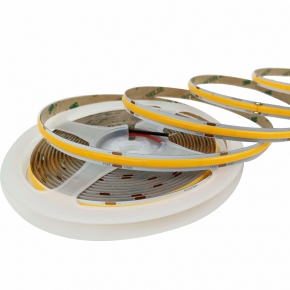
COB technology takes a completely different manufacturing approach. Rather than soldering individual plastic-encapsulated packages onto a board, raw semiconductor dies (usually flip-chips) are mounted directly onto the circuit substrate in extreme proximity.
[COB Strip Visual]
[Die][Die][Die][Die][Die][Die][Die][Die]
=======================================
 Continuous Phosphor Gel Layer Over All
               ↓
     Seamless Linear Beam ($180^circ$)
1. Ultra-High Diode Density
Where a dense SMD strip might pack 120 to 240 chips per meter, a high-spec COB strip routinely houses 480 to 840 micro-chips per meter. Because the individual semiconductors sit virtually edge-to-edge, the physical dark space between emitters is practically zero.
2. Flip-Chip Architecture
Traditional SMDs rely on tiny gold wire bonds to conduct power. COB strips utilize flip-chip technology, where the electrical contacts sit directly on the bottom of the semiconductor. This removes top-side wire blockages, increases heat dissipation through the copper PCB layer, and allows chips to be packed far tighter without electrical interference.
3. Continuous Phosphor Layer
The true secret to dotless light is the yellow silicone phosphor coating applied over the array. On an SMD strip, each diode has its own isolated phosphor blob. On a COB strip, a continuous, uniform strip of phosphor paste is applied over the entire row of dies in a single pass.
This uninterrupted gel acts as an immediate primary diffuser directly at the light source. By the time photons exit the phosphor layer, the individual light cones have blended into a single uniform ribbon of light with a widened beam angle of nearly $180^circ$.
Technical Advantages Over Standard SMD Strips
| Feature | Standard SMD LED Strip | Advanced COB LED Strip |
| Light Output | Segmented / Point-source | Continuous / Linear |
| Beam Angle | $sim 120^circ$ | $sim 180^circ$ |
| Minimum Profile Depth | Requires deep channel ($ge 15text{ mm}$) for diffusion | Works in ultra-shallow channels ($le 5text{ mm}$) |
| Thermal Dissipation | Concentrated at individual solder joints | Evenly distributed across substrate |
| Flexibility & Reliability | Rigid solder points prone to cracking when bent | Uniform stress distribution; fewer wire-bond failures |
Where COB Light Strips Make the Biggest Difference
Reflective Surface Accents: Under-cabinet task lighting above polished quartz or granite countertops, where standard LEDs mirror as harsh dots.
Low-Profile Recessed Slots: Shallow drywall aluminum extrusions where traditional diffusers are too close to the LEDs to hide the points of light.
Direct-View Feature Lighting: Perimeter lighting, millwork channels, and toe-kicks where the light strip itself is visible to the eye.
Commercial Displays: Retail shelving and jewelry cases where uniform color rendering and smooth light distribution are required to highlight product textures.
Specifying the Right COB Strip for Professional Projects
While the physics behind COB strips are straightforward, manufacturing quality varies widely across suppliers. To ensure long-term stability and color accuracy, pay attention to these parameters:
Color Consistency (SDCM): Look for tight binning—ideally within 3-step MacAdam ellipses—to prevent color shift across long runs.
Color Rendering Index (CRI): Aim for CRI 90+ ($R_9 > 50$) for residential and architectural spaces so skin tones and natural materials appear true-to-life.
Copper PCB Thickness: Quality linear lighting relies on $2text{ oz}$ or $3text{ oz}$ double-layer copper PCBs to prevent voltage drop and ensure proper heat sinking.
Established linear lighting manufacturers—such as LEDWAY—have focused heavily on perfecting this balance of chip density, thermal management, and strict binning tolerances. Choosing engineering-focused suppliers ensures that high-density COB arrays maintain high lumen efficiency without sacrificing longevity.
Ready to Upgrade Your Lighting Package?
Whether you are detailing a custom residential millwork package or specifying linear fixtures for a commercial build, dotless COB technology eliminates the guesswork from clean, modern lighting design.
For technical specifications, photometric files, or custom engineering inquiries, reach out to our team directly at sales2@ledwaylighting.com.

High Quality Assurance Professional choice factory supply.

Excellent public repution reassured purchasing

Professional design Personalized lighting product idea design

Fast sample making | fast proofingSamples can be made within 48 hours
About
SHENZHEN LEDWAY LIGHTING CO.,Ltd is a manufacturer which integrating R&D, manufacture and sales. Current factory area is 1800 ㎡, 5 high spend SMT machines, 2 reflow soldering machines, 5 production lines, 80 skilled workers as well as the professional R&D team, sales and service team...
In the past 10 years, LEDway focuses on led strip, such as DC&HV strip, COB&SMD strip, neon led strip, have rich-experience in led strip area. In recent year, with strong R&D ability, we also have developed led cabinet light, sensor night light, atmosphere light. Hot selling in Americas and European market. Most of our products have passed CE ROHS, ETL, GS, KC..
Contacts
-
- Address
- The 5rd floor, factory building, Jianghai industrial Park, Yonghe road No. 7, Shiyan street, Baoan district, Shenzhen, China.
-
- jelly@ledwaylighting.com
-
- We are open
- Mon-Fri: 08:00 - 18:00